

Full Gas Fireplace Inspection in Mint Hill
Mint Hill keeps its lots large and its tree cover heavy, and both of those change what a gas fireplace has to contend with. Chimney Masters inspects venting, flame sensing, gas connections, and seals, with particular attention to the safety controls that matter most when something goes wrong.
LEAVE YOUR CHIMNEY TO THE EXPERTS
☑
EXPERIENCE
Serving your community with pride since 2002. Our long-standing track record speaks volumes about our dedication and skill.
☑
HONESTY
Clear, upfront pricing-no surprise charges, even on weekends or holidays. What you see is what you pay.
☑
RESPONSIVENESS
We’re here when you need us most-same-day service and 24/7 emergency availability all year round.
☑
CRAFTSMANSHIP
Full-service chimney care-from inspections to repairs-performed with cutting-edge tools and high standards.
For emergency service call us at : 888-224-6226
Safety Checks First: Mint Hill NC Gas Fireplace Inspection
Safety-focused fireplace inspections
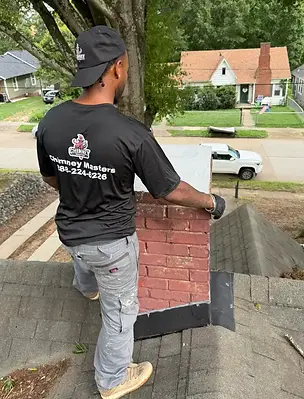
Ashe Plantation, Farmwood, Brighton Park, Bainbridge and Ellington Farm all share something that matters here: space, and a lot of trees. Mature canopy over a house means more debris reaching a vent termination and more chance of a limb finding it during a storm. In Mint Hill, the outside end of the system deserves as much attention as the appliance indoors.

Google Reviews from Our Valued Clients
%20(1).png)
Mint Hill: The Safety Case for an Annual Inspection
A gas fireplace has one job it must never fail at: shutting off the gas when the flame is gone. Everything else is comfort. In Mint Hill, where houses sit further apart and a problem is less likely to be noticed quickly by anyone else, that shutoff working correctly carries real weight. An annual inspection tests it directly rather than assuming last year's result still holds.

Gas Line Integrity Check
Ignition and Burner Safety

We follow the accessible gas line for corrosion, loose fittings, and connectors that have aged past their rated life, paying particular attention to anywhere the line runs through structure or sits against masonry. Anything we find that needs correcting is documented and referred to a licensed gas technician.
Delayed ignition is a safety matter, not just an inconvenience, because gas that accumulates before lighting has to go somewhere. We run repeated starts on your Mint Hill unit, time how quickly the burner establishes, and flag hesitation before it becomes a sharp light-off.

Pilot Flame Reliability
Vent Integrity and Clearance

A pilot that drops out repeatedly is not a nuisance to work around: it means the safety system is doing its job for a reason. We inspect the assembly, confirm the flame sits correctly against the sensing element, and look for the underlying cause rather than just restoring the flame.
Under Mint Hill's tree canopy, terminations collect leaf litter and nesting material every season, and storm limbs occasionally strike them. We inspect the outside assembly, its clearances, and the accessible run for restriction, separation, and impact damage.

Shutoff and Sensor Testing
This is an important safety-related check. We identify whether your unit relies on a thermocouple, a thermopile, or electronic flame sensing, then verify the gas actually shuts off within the expected window when the flame is lost. A shutoff that responds slowly gets reported as a priority finding.

Seal Integrity and Glass
On a sealed appliance, the door gasket keeps combustion byproducts inside the chamber where they belong. A hardened or gapped seal is a containment problem, not a cosmetic one. We check compression around the full perimeter and examine the glass for cracks, chips, and heat clouding.

Mint Hill: Why Annual Safety Testing Belongs on the Calendar


Test It, Do Not Assume It
Safety controls have to work on the day everything else has already gone wrong. We test the shutoff on every Mint Hill visit rather than treating last season as evidence.
Catch Wear Before Failure
Sensors and gaskets degrade quietly and then stop working. Regular checks in Mint Hill mean replacing a component on a planned visit rather than discovering it has already failed.
Clean Burn, Safe Exhaust
Incomplete combustion wastes gas and puts more byproduct into the venting. Correcting flame pattern and media placement in your Mint Hill fireplace improves both output and how safely it exhausts.
Mint Hill: The Safety Sequence We Follow on Every Visit

Check One: Gas Supply and Components
We begin cold, with the supply line, control valve, burner, pilot hardware, and firebox. Recording the state of each before the appliance runs is what makes the later testing meaningful rather than a formality.

Check Two: Venting and Exhaust Safety
Then the venting, indoors and out. We examine the accessible run for separation and corrosion, then check the outside termination for blockage, clearance, and any sign of storm impact, a real consideration under Mint Hill's tree cover.

Check Three: Shutoff Testing and Findings
We finish with the safety controls, verifying that gas flow stops as designed when the flame is lost. Then we go through everything with you, with the safety-related findings first and the rest in order behind them.
Book an Appointment
Schedule a gas fireplace safety inspection in Mint Hill with Chimney Masters. We serve Ashe Plantation, Farmwood, Brighton Park, Bainbridge, Ellington Farm, and Green Meadows, testing safety controls directly on every visit. You get a documented account of what was checked, what passed, and what needs attention.
Homeowners Across the Carolinas Trust Chimney Masters
Exclusive Chimney Service Coupons to Keep Your Home in Top Shape!
Frequently asked questions
What safety components does a gas fireplace inspection cover?
▼
Safety-related evaluation typically covers the flame-sensing arrangement, the control valve, the venting system, and accessible gas connections, though the specific components present vary by appliance and ignition type. Flame sensing may involve a thermocouple, a thermopile, or an electronic sensor, and its function is to stop gas flow when a flame is not detected, so confirming that it responds as designed is a central part of the evaluation. Venting is assessed for separation, corrosion, blockage, and correct clearance, since compromised venting can allow combustion byproducts to escape where they should not. Accessible gas connections are checked for corrosion and secure fitting. Some appliances also include additional controls such as a spill switch or an oxygen depletion sensor depending on type, and these are evaluated where present.
Can delayed ignition on a gas fireplace be dangerous?
▼
Delayed ignition is generally treated as a condition worth addressing rather than tolerating. It occurs when gas is released but does not light immediately, allowing a small volume to accumulate before ignition takes place, which produces a noticeable popping or whooshing sound at startup. Contributing factors can include partially blocked burner ports, a pilot flame that is weak or poorly positioned, an issue with the igniter, or a gas supply condition affecting how the burner receives fuel. Occasional soft sounds during startup are not necessarily the same thing, but a distinct delay followed by an audible ignition is a recognizable symptom. Continuing to operate an appliance showing this behavior is not advisable, since the underlying cause generally does not resolve without attention. A professional evaluation can determine which factor is responsible.
Can storm damage affect a gas fireplace vent?
▼
Yes, and damage of this kind is frequently not visible from inside the home. A falling limb can strike a vent termination or the chimney structure directly, and high winds can loosen or displace a termination cap or the flashing around it. Damage may also be less obvious than an impact, such as a joint separating slightly under load or a termination shifting enough to affect its seal without appearing dislodged. Because a gas appliance can continue to light and run with venting that has been compromised, the absence of any change in operation is not confirmation that the system is intact. Following a significant storm, particularly one involving falling limbs or unusually high winds, having the venting checked where it can be safely accessed is a reasonable precaution before the appliance returns to regular use.
Should a gas fireplace be inspected after storm damage to the roof?
▼
Yes, roof damage is a sound reason to have the venting evaluated, and it is worth considering in Mint Hill, where mature tree cover raises the likelihood of limbs falling during a storm. Repairs to a roof can also disturb flashing or a termination near the work area, sometimes without anyone noticing at the time. Because the exhaust path exits through the roof or an exterior wall, damage to the surrounding structure can affect the venting even when the appliance itself was nowhere near the impact. Checking the accessible portions of the venting and the termination after roof work or storm damage confirms whether the exhaust path is still intact. This is generally worth arranging before the fireplace goes back into regular use rather than afterward.